COP17: WWF urges governments to bridge biodiversity implementation and financing gaps
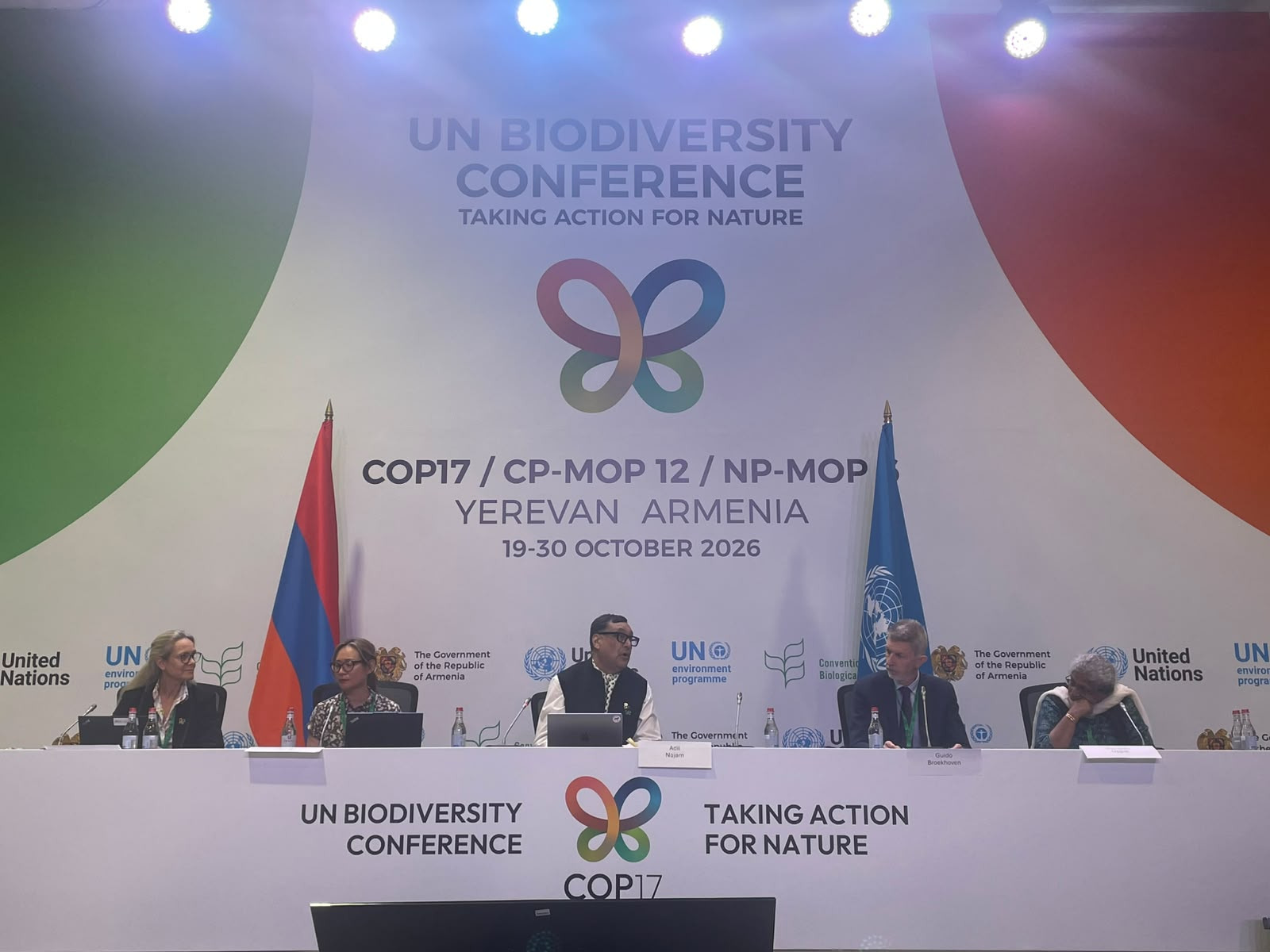
WWF during press conference. Photo credit: Raveloaritiana Mamisoa
YEREVAN, Armenia, 23 October 2026 — The World Wide Fund for Nature (WWF) has called on governments attending the UN Biodiversity Conference (COP17) in Yerevan to turn global biodiversity commitments into concrete action, warning that unresolved disagreements over financing and implementation could undermine progress towards the 2030 targets.
In a press release issued as the conference’s first week draws to a close, the conservation organisation highlighted continuing divisions over the Global Review, resource mobilisation and the financial mechanism. These issues are expected to remain central as ministers prepare to join negotiations on 27–28 October.
WWF argues that closing the gap between biodiversity commitments and their implementation will require stronger accountability, more predictable funding and greater support for countries and communities working to protect nature.
The organisation also emphasised that financial commitments must be matched by practical measures to address the economic activities and incentives contributing to biodiversity loss.
Implementation and financing remain key challenges
According to WWF, countries are still negotiating how COP17 should respond to findings from the first Global Report on the implementation of the global biodiversity framework. Discussions centre on the ambition of national commitments, progress in delivering them and the availability of resources, including finance, capacity-building and technology transfer.
WWF maintains that these challenges are closely connected: governments need both stronger implementation measures and credible financial support to meet their biodiversity commitments.
The organisation has also advocated for regional and subregional dialogues following COP17, arguing that these could help countries exchange experiences and improve accountability. It further called for stronger participation by Indigenous Peoples, local communities, women and young people in biodiversity planning and implementation.
Guido Broekhoven, WWF’s Interim Global Director of Multilateral Policy, said the upcoming ministerial discussions would be an important opportunity to translate evidence of insufficient implementation into practical decisions. He also stressed the need to deliver the international target of US$30 billion annually in biodiversity finance for developing countries by 2030.
WWF argues that achieving the global biodiversity mission will also require changes to economic and financial systems and a transition towards more sustainable practices in sectors driving biodiversity loss.
.

Financing disagreements complicate negotiations
Resource mobilisation and the financial mechanism have emerged as particularly difficult issues, according to WWF. Negotiators are divided over the obligations of developed countries to provide international public finance and proposals to expand the group of countries contributing to biodiversity funding.
The organisation noted that negotiations on these questions have moved into closed contact groups, while the packed agenda has left limited time for other issues. These include biodiversity financing beyond 2030, coordination between biodiversity and climate finance, and reform of incentives that harm nature.
WWF also pointed to the proposed Friends of Target 18 group, expected to launch during Finance Day on 26 October, as a possible avenue for advancing discussions on harmful incentives.
Celine Beaulieu, WWF’s Head of Public Sector Partnerships, said negotiators were considering eight options for broadening the contributor base. She urged governments to make progress before the ministerial segment, noting the importance of advancing the resource mobilisation roadmap and developing a financing framework for the period beyond 2030.
Questions remain over the Cali Fund
The Cali Fund is another focus of the negotiations. Designed to mobilise contributions from businesses benefiting from the use of digital sequence information on genetic resources, the mechanism is expected to raise between US$1 billion and US$10 billion annually.
WWF reported that, by the end of the first week of COP17, five companies had committed a combined US$10,656, with two of the companies having announced pledges rather than completed payments.
Negotiators continue to consider who should contribute to the fund, how to avoid duplicate payments through national and international arrangements, and whether contributions should be required only from large companies or from a wider range of businesses.
The unresolved questions will shape how the mechanism operates and whether it can mobilise resources at the scale envisaged.
Indigenous Peoples and local communities seek meaningful involvement
COP17 discussions are also addressing the work programme and operating arrangements of the permanent Subsidiary Body on Article 8(j), established at COP16 to strengthen the participation of Indigenous Peoples and local communities in the Convention on Biological Diversity.
WWF highlighted the importance of protecting the self-determination of these groups and respecting their existing governance structures and decision-making processes.
Cristina Eghenter, WWF’s Senior Expert in Global Governance, stressed that Indigenous Peoples and local communities should have direct access to funding that supports priorities identified by the communities themselves. She argued that funding arrangements should reflect different governance systems rather than impose a uniform approach.
The organisation also highlighted community-led conservation in Africa, including efforts to restore rangelands, wetlands and forests while supporting livelihoods and strengthening resilience to climate change. The Barotse Floodplain in Zambia was cited as one example of the contribution communities can make to biodiversity protection.
Nalucha Bernadette Nganga, Country Director of WWF Zambia, called for greater support for communities and conservation practitioners working on the ground, emphasising the importance of secure rights, meaningful participation and access to resources.
Other agenda items make progress
While financing and implementation remain contentious, WWF reported faster progress on several other negotiating topics. These include guidance relating to sustainable wildlife management, protected areas, marine and coastal biodiversity, island ecosystems, gender and public awareness.
The Gender Plan of Action and Communication, Education and Public Awareness were expected to be considered for adoption at the plenary on the evening of 23 October, according to the organisation’s statement.
As the conference enters its next phase, the remaining negotiations will test whether governments can reach agreements that combine ambitious biodiversity commitments with the financing, accountability and practical support needed to implement them.
For WWF, the ultimate measure of COP17’s success will be whether decisions made in Yerevan translate into tangible improvements for nature and the communities that depend on it.
This story was produced as part of the 2026 CBD COP17 Fellowship, operated by Informed Earth in collaboration with Internews’ Earth Journalism Network


